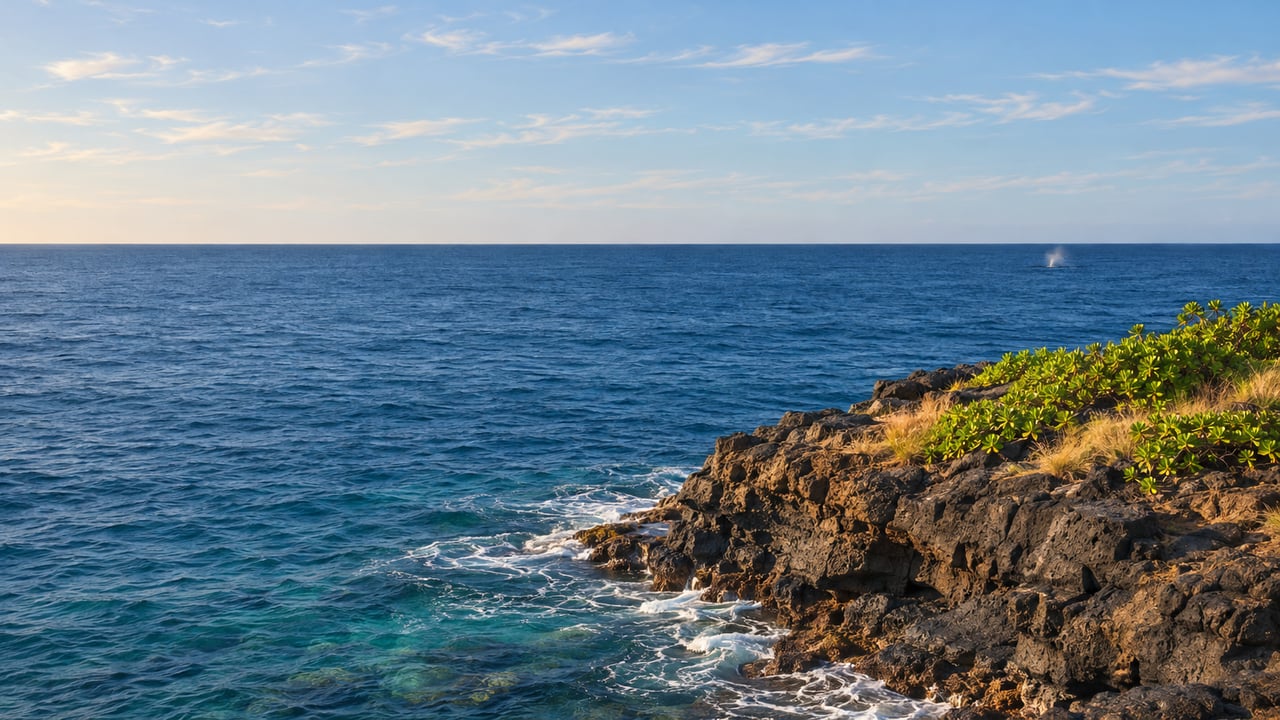
At 8 a.m. on January 31, 2026, the volunteers counting whales at Makahūʻena Point logged 10 adult humpbacks and 5 calves in their first 15-minute window. No other Kauaʻi count site recorded that many calves in a single window all morning. Over the next four hours the point never dropped below four adults per window, and at 9 a.m. the team counted 13 adults and 3 calves.
Kauaʻi held three Sanctuary Ocean Counts last winter, and set side by side they show shore watching on the Poipu coast peaking early. In January it was among the best on the island. By the end of February the best view had moved up onto the bluff, and by late March the three South Shore count sites were close to empty while the west side was still busy. For anyone in Poipu Beach Estates who plans to watch from the lookouts down the hill this winter, the month you go matters more than which lookout you pick.
January Belonged to the South Shore
The Sanctuary Ocean Count runs from 8:00 a.m. to 12:15 p.m. on the last Saturday of January, February and March. Volunteers at fixed shoreline sites record the humpbacks they see in each 15-minute period. On the January 2026 count, Kauaʻi recorded 467 whales across its participating sites. The Garden Island reported that this was more than any other participating island that day: Oʻahu and Hawaiʻi Island each counted 337 and Molokaʻi counted 52.
Poipu's three sites did their share of that. According to the January 31 preliminary results, the Māhāʻulepū-Makawehi team opened with 8 adults and 3 calves, then counted 9 adults and 3 calves in the 8:30 window. Poʻipū Beach Park saw nothing in its first window, then counted between 3 and 7 adults in every window after that until 12:15. Kauaʻi's sites averaged 5 whales per 15-minute period that morning. Makahūʻena Point beat that average in most windows.
The island's single biggest number that day came from Port Allen Cemetery on the West Side, where the team counted 20 adults and no calves in the 9:00 window. Makahūʻena stands out for something steadier. Calves showed up in all nine of its windows, and in the first two there were five at a time.
February Moved the Best View Up the Bluff
Four weeks later the picture had changed. On the February 28, 2026 count, Kauaʻi's sites averaged 4 whales per period. On the South Shore the drop was much steeper. Makahūʻena Point, the busiest of the three in January, counted between zero and 2 adults in every window until noon, then 4 in the last one. Poʻipū Beach Park topped out at 4.
Māhāʻulepū-Makawehi did better than both. The bluff at the east end of Shipwreck Beach recorded calves in most of its windows and finished at noon with 6 adults and 3 calves, the strongest Poipu window of the day. The February 28 results also show the island's best numbers moving elsewhere. Ninini Lighthouse near Līhuʻe counted 8 adults and 3 calves at 11:00, and the Pacific Missile Range Facility on the West Side counted 4 to 6 adults in every window.
By Late March the Count Had Moved West
The March 28, 2026 count is where the South Shore's early season shows most plainly. Kauaʻi's average fell to 2 whales per period. According to the March 28 results, Makawehi counted one whale, at 9:00, and nothing in its other eight windows. Makahūʻena Point counted 2 at 8:30, 1 at 9:00 and 1 at noon. Poʻipū Beach Park saw one whale all morning, in its last window.
The Pacific Missile Range Facility, out past Kekaha, opened that same morning with 10 adults and 2 calves and stayed between 3 and 7 adults in every window that followed. The Kapaʻa Lookout on the east side kept counting too, with up to 5 adults in a window.
These three counts are snapshots of three mornings. The figures are sightings, and the same whale can be counted more than once. Still, the pattern held from count to count: the Poipu coast was busiest at the end of January, thinner at the end of February, and nearly empty by the end of March. In Poipu, the strongest stretch for shore watching runs from the holidays into January, a little ahead of the statewide peak.
Three Lookouts Along the Coast
The three Poipu Ocean Count sites are also the three easiest places to watch on this stretch of coast, and all three had their best morning of last winter in January.
Makahūʻena Point is the place to start in January. It's a roadside pull-off along Peʻe Road with no parking lot, so you park along the road and walk out to the shoreline. On the January count it recorded more calves in a single window than any other count site on Kauaʻi.
The Makawehi bluff rises above the water at the east end of Shipwreck Beach, and you reach it from the Shipwreck Beach lot. Being up higher makes a real difference when you're scanning for blows, and when the February count thinned out, the bluff kept the strongest numbers of the three Poipu sites. The lithified dune cliff is undercut in places and the rock is softer than it looks, so stay well back from the edge. The bluff is also where the Māhāʻulepū Heritage Trail starts. The trail runs about two miles east along the coast to Punahoa Point, and it crosses Grove Farm land that is open by permission, behind a gate that opens in the morning and closes in the evening. Parts of that coast are burial ground, so stay on the established path.
Poʻipū Beach Park is at sea level, so whales are harder to spot from there than from the bluff. It's still a reliable January stop, as its steady mid-morning numbers last winter show. The County of Kauaʻi closed the park on November 12 for Hurricane Lowell recovery work, including returning displaced sand to the beach, with reopening scheduled for November 13. The County posts current park and shoreline access on KauaiRecovers.org, and it's worth a look before heading to any of the three spots.
At any of the three, watch first for the blow, a puff of mist that hangs over the water for a second before it disappears. Keep your eyes on that patch of ocean, because a back or a tail often follows. Mornings are usually easier, before the trade winds chop up the surface.
Late November Is the Early Part of the Season
The Hawaiian Islands Humpback Whale National Marine Sanctuary gives Hawaiʻi's humpback season as November through April. The first whales usually arrive before the season officially starts. Last year, Kauaʻi Now reported that Holo Holo Charters recorded the first sighting of the 2025–26 season off Kauaʻi at 7 a.m. on October 14.
Spouts this late in November are the early arrivals. The 2026 counts suggest that, from the Poipu shoreline, the best mornings come about two months from now.
Counting in 2027
The 2027 Sanctuary Ocean Count falls on January 30, February 27 and March 27. Each count has its own registration window, January 4 to 18, February 1 to 15 and March 1 to 15, and each window opens and closes at noon HST. Volunteers register at oceancount.org, choose a site, commit to the full count, and arrive before 8 a.m. for instructions. Each volunteer fills out their own form. The sanctuary's Ocean Count page lists Cindy Among-Serrao as the contact for volunteers. Statewide, 433 volunteers took part in the January 2026 count.
The site list depends each year on whether a site leader is available and access permission is granted, so look for Makahūʻena Point, Māhāʻulepū-Makawehi and Poʻipū Beach Park when registration opens rather than assuming they're on it. If they are, the January 30 count is the one to sign up for. Last year that was the morning Makahūʻena Point counted calves in every window.
If you're thinking about a home where your morning walk could take you out to Makahūʻena Point or the Makawehi bluff, Ilona Coffey is glad to walk that stretch of coast with you, in person or by video from the mainland. Request a private Kauai consultation.